

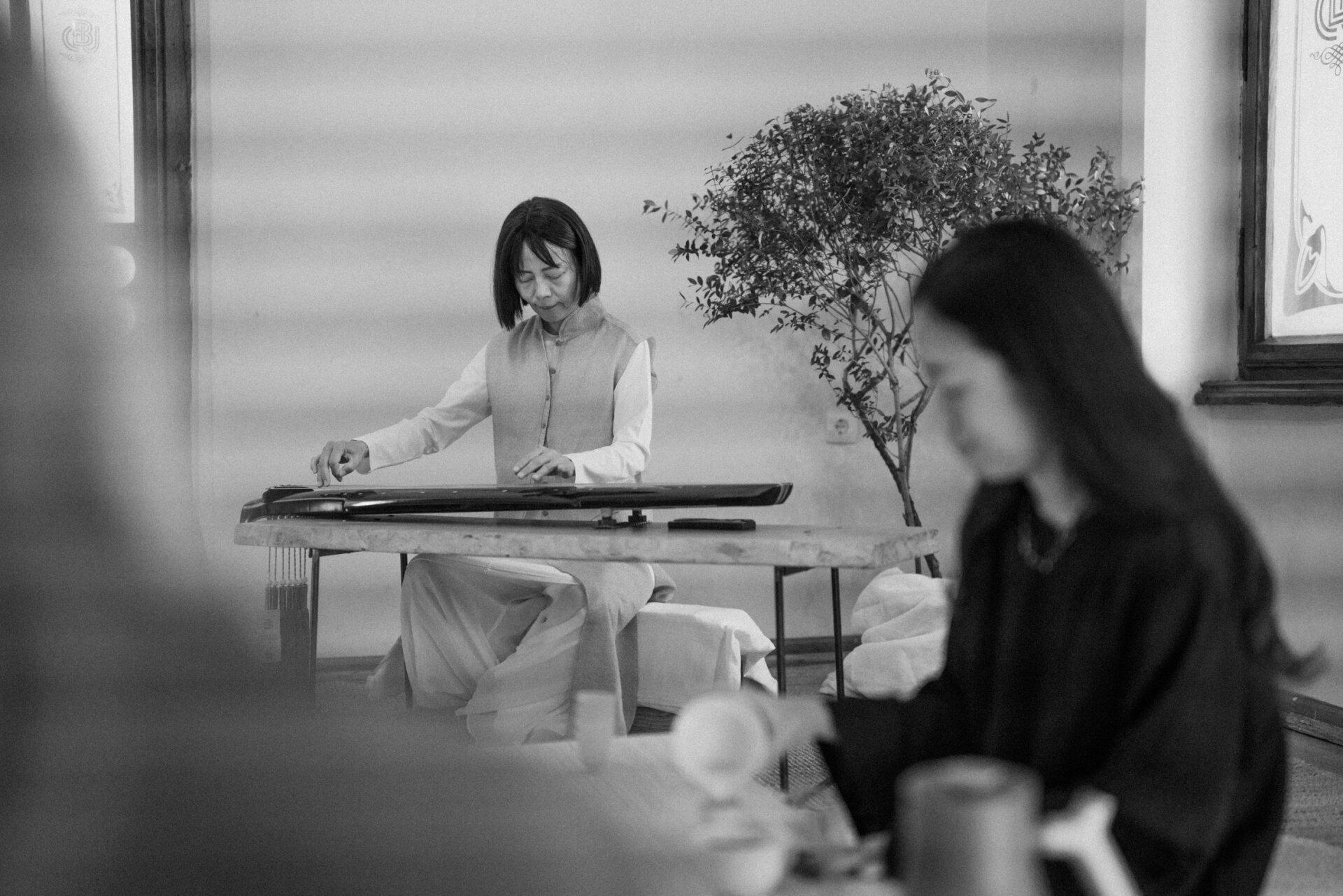
Liu Chengyin, Architect, Senior Guqin Teacher & Founder of Juntian Miaoyin Guqin Society : „People need a place where they can return to themselves and be present”
How does an architect’s structural eye meet the contemplative stillness of an instrument with over three thousand years of history? For Liu Chengyin, the answer lies in the art of creating space, both the physical environments we inhabit and the inner sanctuary we build within ourselves. An architect and founder of the Juntian Miaoyin Guqin Society, Liu Chengyin is celebrated for a playing style marked by serenity, clarity, and an effortless balance between strength and delicacy. Speaking in the context of Unfinished, she shares how an ancient aesthetic philosophy can guide the modern soul through sensory overload, how women can preserve an authentic internal rhythm amid endless roles, and why true creative refinement never has a fixed finish line.
You navigate two fascinating, yet seemingly distinct disciplines: architecture and the sacred art of the guqin. Where do these two worlds meet in your practice, and how do they inform one another?
Architecture and the guqin share the same essence: both are about creating space. One constructs a physical space, while the other creates an inner, spiritual space. This is where the two meet.
As an architect, I consider scale, solid and void, and spatial sequences, always thinking about how people feel when they experience a space. Playing the guqin involves similar considerations—the balance between presence and absence, density and openness, empty space, and breath. Architecture can be seen as frozen music, while music can also create a sense of space and time.
In architectural design, the guqin has taught me restraint and simplicity, and not to overcomplicate things. When playing the guqin, my architectural training gives me a sensitivity to proportion and layers, helping me understand the overall structure of a piece of music. The two disciplines nourish each other—one still and one moving, one tangible and one intangible—and together they shape the way I perceive the world.
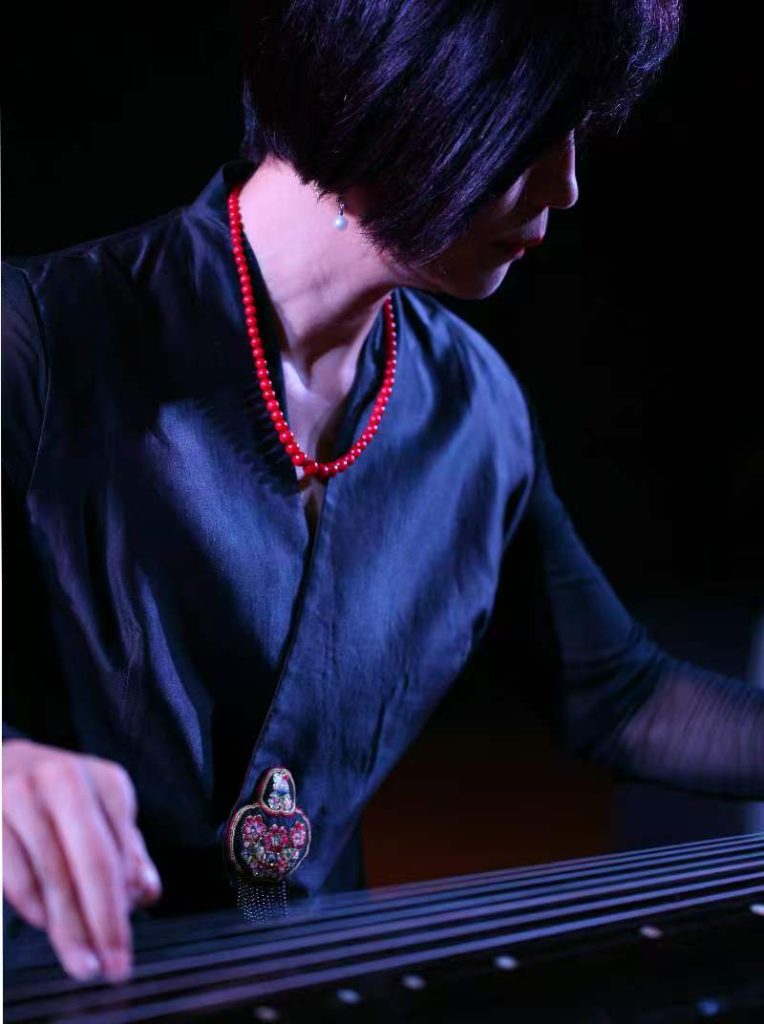
In architecture, you shape tangible, lasting structures, whereas music is ephemeral, dissolving the moment a note fades. What does each of these mediums offer to your creative spirit?
Architecture has taught me to respect permanence.
A building made of brick and stone can stand on the earth for a very long time. It requires careful and restrained creation, with consideration for time, materials, and how people will live with the space over the years. It teaches me patience and a lasting sense of responsibility for my work.
Guqin music, on the other hand, has taught me to accept impermanence.
A note begins in an instant, and once its sound fades, it is gone. Playing the guqin allows me to let go of pursuing an outcome and simply be present, focusing on each note as it happens. Every time I pluck a string, it feels like a new creation, transmitting the breath and state of mind of that particular moment through my hands to the instrument.
Architecture and the guqin offer two different ways of creating: one seeks permanence, while the other embraces disappearance.
Architecture strengthens my rationality and steadiness, while the guqin nurtures my sensitivity and awareness. Together, they bring balance to my creative practice.
The guqin is one of the world’s most ancient instruments. What part of its timeless philosophy remains truly essential for the modern soul today?
Indeed, written records of the guqin go back more than 3,000 years, and surviving instruments unearthed by archaeologists date back more than 2,000 years. Across this long history, the guqin has carried a philosophy of looking inward, finding stillness, knowing when to pause, and appreciating subtlety and simplicity.
In today’s fast-paced world of information overload, I think the guqin’s most important value is its ability to guide us back to ourselves. When playing, we need to let go of distracting thoughts, become aware of our breathing and state of mind, and practice being present. Its aesthetic philosophy is equally important: it does not seek showiness or technical display, but values simplicity, restraint, and freedom from the pursuit of external recognition. This mindset of not constantly competing with others can help us let go of some of the anxiety created by comparison.
Ultimately, the guqin carries a philosophy of life: to maintain inner calm between movement and stillness, and to preserve a quiet space of one’s own amid the complexity of the world.
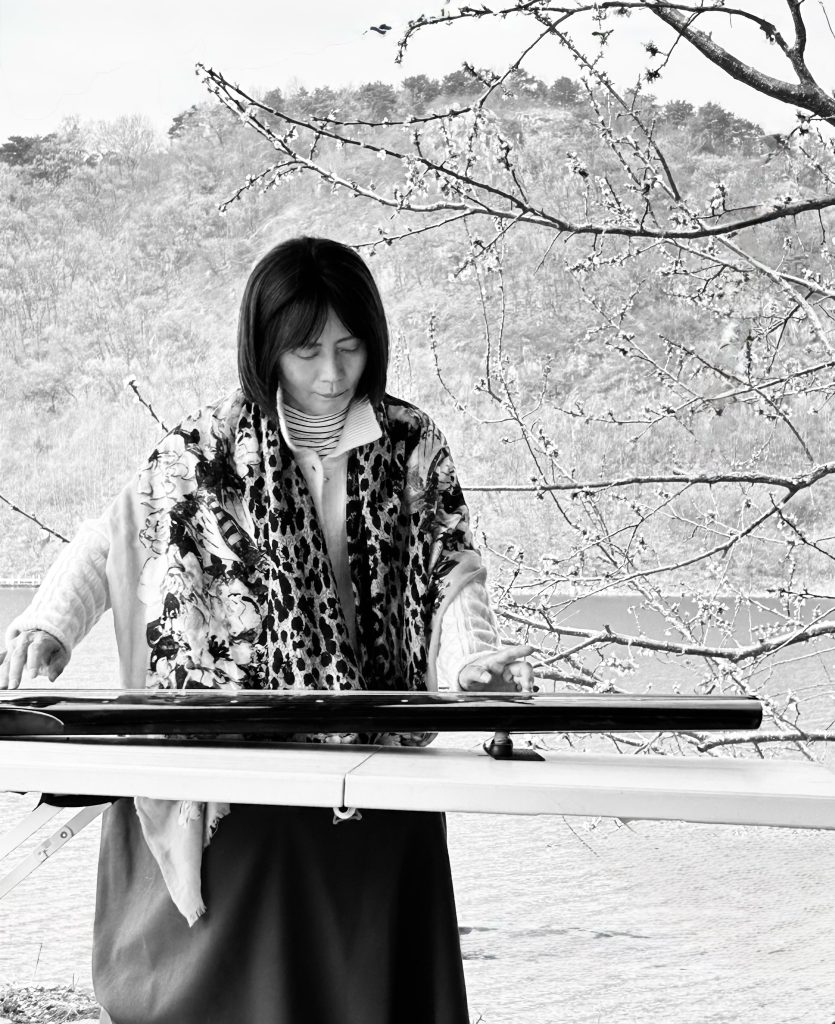
Having studied under several renowned masters in China, you went on to establish the Juntian Miaoyin Guqin Society. Beyond technique, what was the most enduring life lesson you inherited from your mentors?
While teaching me the technique, artistry, and philosophy of the guqin, my teachers also influenced me deeply through their own character and integrity. They taught me that learning the guqin is also a form of self-cultivation.
They taught me that the sound of the guqin ultimately comes from the inner state of the person playing it. When the mind is calm and peaceful, the music naturally becomes serene and spacious; when the mind is restless and distracted, the sound becomes unsettled. Learning the guqin is not about pursuing technical display or recognition, but about patiently cultivating one’s character, humility, and self-discipline over time.
This philosophy also guided me when I founded the Juntian Miaoyin Guqin Society. Alongside teaching technique, I hope to pass on this idea of looking inward and finding a sense of inner peace through the practice of the guqin.
I am deeply grateful to my teachers and everything they have taught me. The lesson that has stayed with me most throughout my life is: “The guqin itself is your teacher.”
What unspoken need or void did you perceive around you when you decided to bring the Juntian Miaoyin Guqin Society to life?
I noticed that although many people live materially comfortable lives, they often still feel unsettled inside. There seems to be a lack of a space where they can slow down, reconnect with themselves, and reflect inwardly.
In today’s learning environment, much of guqin teaching focuses heavily on technique and on learning quickly, which can easily reduce the guqin to simply another skill to master. What I felt was missing was a space where people did not need to compete, perform, or demonstrate their abilities, but could instead use the guqin as a way to quiet the mind, experience the music, and cultivate themselves.
People need a place where they can return to themselves and be present.
This is what inspired me to establish the Juntian Miaoyin Guqin Society. I hope it can provide such a space, where people can let go of judgment and comparison and gradually find a sense of calm and grounding through the sound of the guqin.
In an era defined by speed and instant gratification, is the younger generation still drawn to an instrument rooted in slowness? What is that learning journey like for them?
The younger generation is still drawn to the guqin, although their reasons may be different from those of people in the past. Living in a world of information overload and instant feedback, many young people actually develop a desire to slow down. The guqin cannot be mastered quickly and does not offer immediate results. Instead, the process of learning—and even the simple moment of plucking a string—becomes a valuable experience in itself.
For them, learning the guqin is not only about learning an instrument, but also a journey of self-awareness. At the beginning, they need patience to work through repetitive practice and basic techniques. Through daily practice, they gradually learn to become aware of their breathing, listen carefully to the sound, quiet distracting thoughts, and become more comfortable with their own emotions. In the gentle, lingering sound of the guqin, they can find a quiet moment of their own, away from the noise and distractions of everyday life.
Through the guqin, you cultivate the art of presence and inner stillness. How can a modern woman—navigating endless roles and pressures—reconnect with her internal rhythm when the outside world feels overwhelmingly loud?
What the guqin has taught me is not to shut out the noise of the outside world, but to learn how to maintain an inner sense of stability within it. Modern women often carry many different roles at once, with their energy constantly divided between responsibilities. It is easy to become caught up in the rhythm of the outside world and lose touch with our own.
In reality, we cannot remain in a state of stillness all the time. When it is time to work, take care of the home, or communicate with others, we should simply give these things our full attention, letting go of unnecessary expectations and complaints, and doing the best we can. When we are fortunate enough to have a moment of pause, we can stop, notice our breathing, bring our attention back to ourselves, and reconnect with our own physical and emotional state and natural rhythm.
This does not mean withdrawing from the world. Rather, it is about developing the ability to find calm within ourselves. No matter how busy life becomes or how circumstances change, we can preserve a small inner space of our own and continually find our way back to ourselves.
Unfinished revolves around the state of continuous evolution. In the world of guqin, is a piece of music ever truly finished? Does perfection exist, or is it simply an endless journey of refinement?
In the world of the guqin, a piece of music is never truly “finished.” The process of continuously refining it and discovering new understanding is perhaps the most beautiful and fascinating part.
The same piece can sound different when played in different seasons, different states of mind, or different stages of life. The score provides only a framework; the music itself reflects the player’s state of mind in that particular moment. As our life experience and understanding deepen, our interpretation of the music continues to evolve.
This idea of being “unfinished” is at the heart of the guqin. Through playing a piece again and again, looking inward, adjusting, and gradually deepening our understanding, the endless journey of refinement becomes part of the meaning of playing itself.
What emotional resonance or state of mind do you hope to leave with the audience after your presence at Unfinished?
I hope the music of the guqin leaves the audience with a subtle and lingering feeling. Even after the final note fades, I hope they can hold on to a moment of stillness and sense that everything in life is continually growing and evolving, without a fixed endpoint.
I hope they can also feel that imperfection and incompleteness are natural parts of life. We do not need to be attached to the pursuit of a perfect destination. Instead, we can learn to accept ourselves and what surrounds us as they are in the present moment, and through continuous practice and awareness, find peace within our own journey through life.
Your fondest travel memory:
Salar de Uyuni in Bolivia—the mirror of the sky. I played the guqin on the salt flats at sunrise and sunset, and in those moments, I felt completely at one with the instrument and the landscape.
A tea or a scent that grounds your creative process:
I love aged Pu-erh tea. Its aroma is deep and warm, with woody and aged notes that are subtle rather than overpowering. The tea is smooth and mellow, with a rich body and a lingering sweetness after each sip.
When I sit quietly and drink it, its gentle and understated character helps me gradually relax, calm my thoughts, and settle into the present moment. It is especially suited to grounding myself before playing the guqin or beginning to develop an architectural design.
An instrument you wish you could play (other than the guqin):
I am currently learning to play the xiao, a traditional Chinese vertical flute. Its sound is clear, gentle, and distant, with a soft and lingering breath. Its lower notes are calm and restrained, while the middle range is delicate and expressive, with an almost ethereal quality.
The xiao pairs beautifully with the guqin: one solid and one airy, one like a pearl and the other like a fine thread. Together, they create the subtle, serene atmosphere traditionally associated with Chinese literati culture.
A daily ritual you never skip:
I meditate and read every day.
Note to self:
Accept yourself as you are, and grow freely.

Autor: Sânziana Fărăgău - Dragoș
Sânziana Fărăgău - Dragoș își găsește echilibrul în sala de sport, iubește timpul petrecut cu prietenii și vacanțele care îi aduc inspirație. Cei care o cunosc spun despre ea că pune suflet în tot ceea ce face, fiind perseverentă și ambițioasă, mereu în căutare de noi provocări și oportunități de creștere. Scrisul este pentru ea o sursă de creativitate și un mod de a se exprima liber.
You may also like

Festivalul UNFINISHED 2026 la București: Tema Multiplicity și Speakeri
Între 25 și 27 septembrie, festivalul multidisciplinar UNFINISHED revine la București cu tema MUL
UNFINISHED 2023: Experimente sociale, sesiuni de dans, mese family-style, dezbateri, blind dates și multe alte experiențe
Mai sunt 8 zile până când o seră istorică, o casă de patrimoniu de 151 de ani și o grădină
