

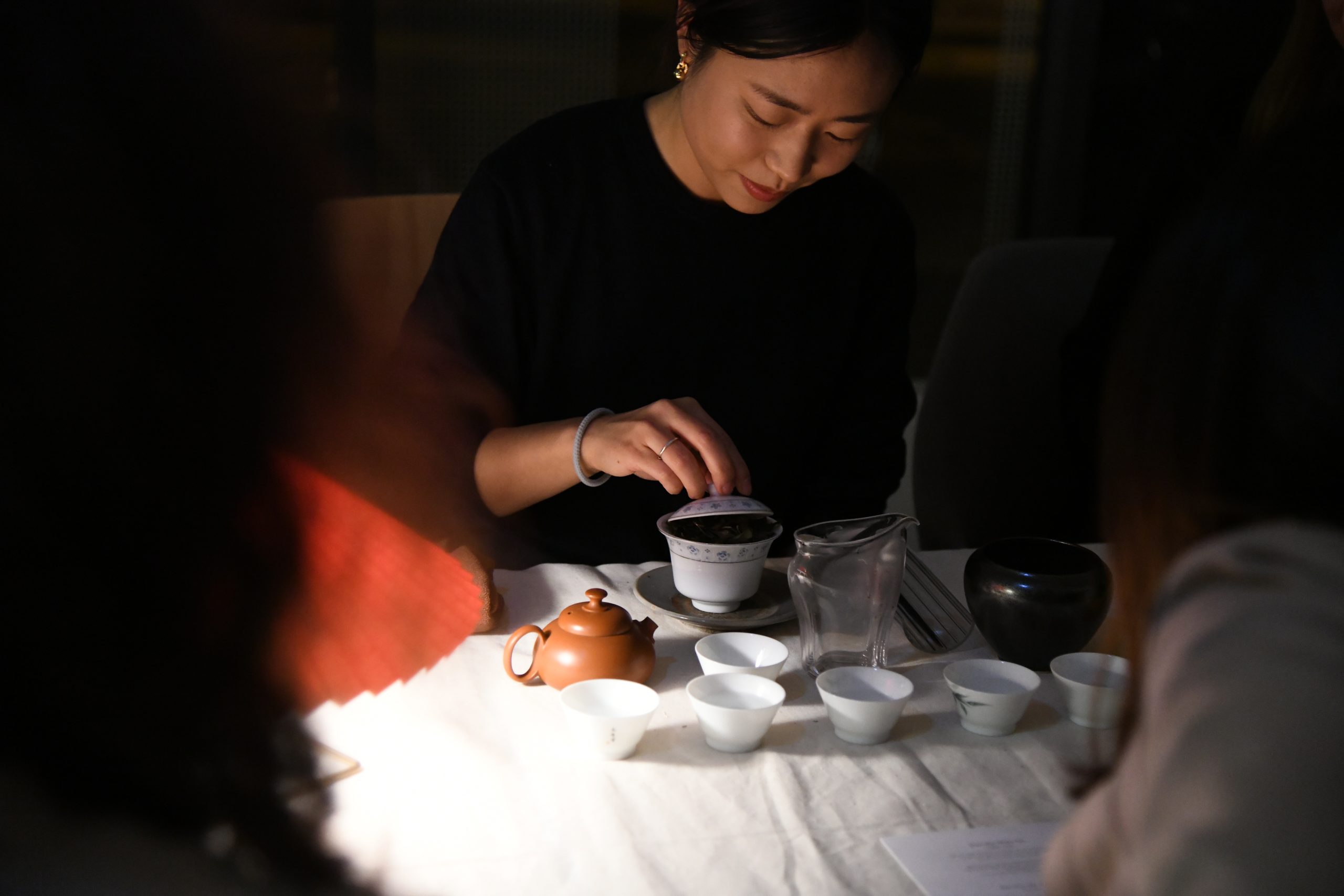
Weirong Li, landscape architect, tea curator and experience designer: „Being unfinished, to me, means that not every thought has to be spoken, not every gesture has to be corrected, and not every behavior needs to be controlled.”
For Weirong Li, a table is never just a piece of furniture, and tea is never just a warm beverage. With a background in landscape architecture, she translates the vastness of natural spaces into the intimate choreography of a single teacup. As an experience designer, tea curator, and founder of Lonely Panda Tea & Culture Studio and the Pink Table initiative, nurtured across both Bucharest and Paris, Weirong approaches tea as a catalyst for genuine human connection, sensory memory, and hospitality.
In a world driven by acceleration and constant motion, her rituals carve out pockets of quiet presence. Ahead of her presence at UNFINISHED, we sat down with Weirong to explore how spatial design meets the quiet art of whole-leaf tea, why true community requires leaving blank spaces, and what it truly means to embrace the beauty of remaining unfinished.
With a solid background in landscape architecture, how did your focus shift from the vast scale of open landscapes to the intimate scale of a single teacup and a shared table?
„To me, a tea table is a micro-landscape where every little element comes into play to create a holistic experience.”
Landscape design is a way for people to understand and connect with a site, and from that perspective, the tea table has a similar function. If designed carefully, it becomes a powerful tool to shape perceptions, guide movement, and foster connections.
In experience design, the most powerful elements are often invisible – rhythm, light, scent, silence. How do you orchestrate the atmosphere of a gathering so the space actively nurtures human connection?
Surprisingly, tea itself already does a lot of these things naturally: the sound of a pour, the colors of different infusions, the pauses between servings, and its natural ability to bring people together. We try to cultivate these existing qualities and amplify their effects.
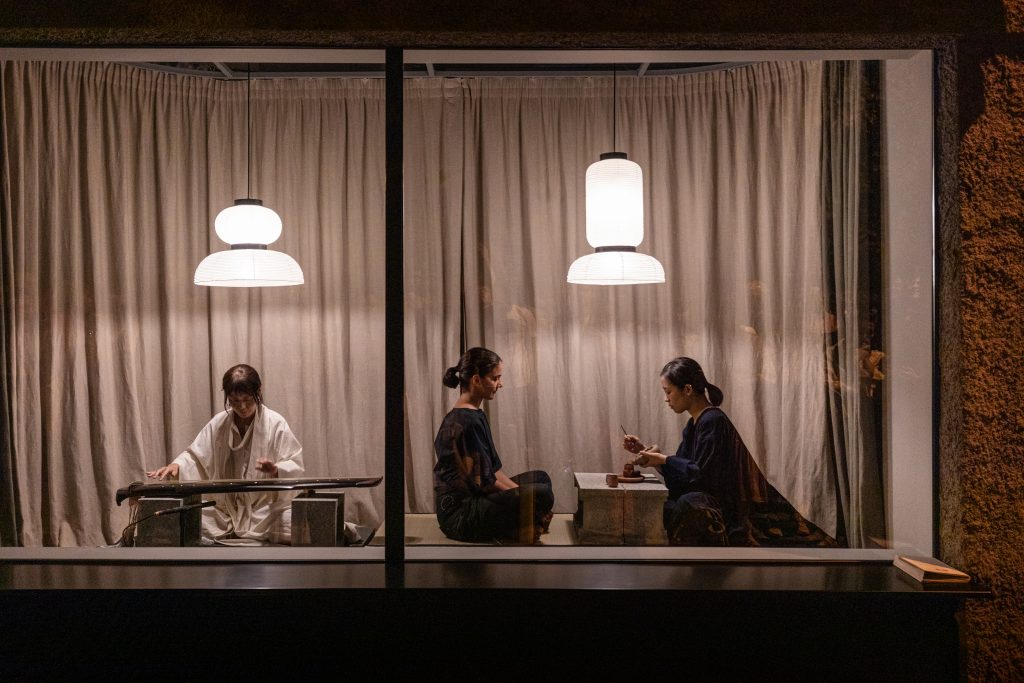
Every little detail can be designed. A tea can be offered directly into a guest’s hands, served in a vessel that invites them to pour it themselves, or passed from one guest to another in a guided setting. Each sequence creates a different relationship between the tea, the space, and the people around the table.
We intentionally design the format, sequence, and elements of each tea event to reflect its concept or theme, while using these small interactions to shape how people experience and connect with one another.
For many, tea is simply a warm drink; in your vision, it is a medium for perception and hospitality. What can the ritual of tea teach us about patience and presence in today’s fast-paced world?
I think we all know that we live in a fast-paced, tech-dominated world, where we can do many things and be in many places at once, whether we want to or not. Interestingly, from what we’ve observed with guests during our tea rituals, many of them find themselves having a moment of peace without even realizing it or forcing it.
„You don’t have to make a great effort to slow down, the ritual itself creates the space for you to do so.”
That, I think, is the power of a tea ritual. If you simply show up and are present for five minutes, it already counts.
How do you guide guests at your tastings beyond a simple „I like it / I don’t like it,” helping them tap into a deeper sensory memory?
Again, tea does this very naturally. Whole-leaf tea has a complex flavor profile that combines aromas, tastes, textures, and aftertastes, so it is rarely a singular experience. A cup of whole-leaf tea can bring you back to a memory, evoke a familiar smell, or spark an exciting conversation with other guests about what it reminds you of.
As a host, I try to give a broad overview of the tea’s flavor profile and explain some of the reasons behind it, just to jump-start the experience. Sometimes, you only need to give very subtle hints, reminding guests to smell the empty cup, for example, so they don’t miss a wonderful lingering aroma. Most of the time, the conversation then unfolds naturally.
In tea culture, every gesture and object carries weight. Which tool or object in your daily practice holds the deepest meaning for you, and what story does it carry?
I think a nice tea pot is always very dear to me. There’s a small pleasure in picking out a favorite “toy” each time before making tea, since I have so many and the collection seems to be growing. My dad also loves giving me teapots, so whenever I use certain ones, I’m reminded of him, which always makes me happy.
Having developed projects in both Bucharest and Paris, how do these two cities embrace tea culture and contemporary hospitality? Have you noticed different rhythms or sensibilities between the two audiences?
I started my tea projects in Bucharest. Living there brought a strong sense of nostalgia for home, and tea became a way for me to stay connected to it. Romania also has its own culture of herbal infusions and local plants, which I love, and I think people should be much prouder of it and talk about it more!
The guests I’ve encountered in Bucharest and elsewhere in Romania are very curious about whole-leaf tea—its flavors, its rituals, and the culture surrounding it. They seem particularly drawn to the ritual aspect, and some have even started practicing it themselves.
In Paris, there is already a stronger baseline tea culture, with new tea places and concepts appearing all the time, so tea itself is less of a novelty. I find that guests here are often more drawn to the overall experience than to the specific teas, while remaining very curious about what they are drinking.
Through initiatives like Pink Table, you reimagine the gathering around a table. How does intimacy emerge among people who may have never met before that shared moment?
The intention of Pink Table is to let the guests guide the table rather than the host. Guests are given a chance to enjoy the tea without the constant involvement of the host, which is not so common at a conventional tea table.
„I really enjoy seeing these exchanges fueled by tea, but not necessarily about tea.”
I’ve noticed that guests quickly start exchanging among themselves, beginning with a smile or a quick introduction. From there, the conversation naturally develops and often moves on to other subjects, far away from tea.
What is the story and philosophy behind the name Lonely Panda Tea & Culture Studio? At what point did you realize this concept simply had to come to life?
My husband and I founded it back in 2022, when we moved to Bucharest after both having lived away from our home countries for a long time. I found myself at a stage in my life where I was craving a certain connection to my roots—I suppose a feeling you could simply call “homesickness.” 🙂
A tea table was always a key part of the home I grew up in. Later, after I got married, my husband also became accustomed to the idea of sitting around the tea table for a few hours in the afternoon, simply spending time together as a family. For both of us, tea came to symbolize connection.
„There was something about living in Bucharest that made you feel like anything was possible.”
We wanted to do something around that idea, so when we found ourselves in Bucharest, a place that felt a little unfamiliar and new to us at the time, the idea of a tea studio started to emerge. And it very quickly turned into action.
The name was partly inspired by the animated film Turning Red, which tells the story of a second-generation immigrant girl in Toronto who turns into a red panda when she gets emotional. It might seem a little far-fetched as a connection to tea, but the film touched me. We also wanted a name that felt cute, approachable, and easy for people to remember. And there it was: The Lonely Panda.
Your craft is centered around holding space for others, attuning to their comfort and emotions. What does your own private ritual look like when it is time to recharge?
Selecting the tea utensils I feel like using in that particular moment, thinking ahead about what tea I want to make, and having a good movie or a good book nearby—that’s how I like to spend my own tea time. Or, simply, sharing it with friends or family.
In both tea culture and landscape architecture, there is a deep reverence for imperfection and continuous evolution (much like wabi-sabi). What does the state of being „unfinished” mean to you, both in design and in everyday life?
To me, being unfinished means that you have to leave space. A tea ritual is not completed by me alone—it is the tea, the people, even the weather of the day, all coming into play. It is the same with landscape: a designer can establish the initial conditions, but has to leave space for nature, the users, and the seasons to take their course.
„Being unfinished, to me, means that not every thought has to be spoken, not every gesture has to be corrected, and not every behavior needs to be controlled.”
In life, too, I’d like to think that we need to leave some blank space in everything—for us to receive, to listen, and to give.
What feeling, sensory imprint, or thought do you hope participants take away after meeting you at Unfinished?
A sense of serenity, relaxation, and happiness.
The first thing you do in a new city:
Coffee or breakfast at a local spot.
The flower or plant that reflects you best:
A pine tree.
A place in Bucharest or Paris that sparks your creativity:
Malmaison, Palais Royal, and the Centre Pompidou.
A question you wish people would ask you more often:
What have you discovered recently, or what’s your latest obsessions?

Autor: Sânziana Fărăgău - Dragoș
Sânziana Fărăgău - Dragoș își găsește echilibrul în sala de sport, iubește timpul petrecut cu prietenii și vacanțele care îi aduc inspirație. Cei care o cunosc spun despre ea că pune suflet în tot ceea ce face, fiind perseverentă și ambițioasă, mereu în căutare de noi provocări și oportunități de creștere. Scrisul este pentru ea o sursă de creativitate și un mod de a se exprima liber.
You may also like
Weirong Li, arhitectă peisagistă, curatoare de ceai, designer de experiențe: „Pentru mine, ideea de unfinished înseamnă că nu fiecare gând trebuie rostit, nu fiecare gest trebuie corectat și nu orice comportament are nevoie să fie controlat.”
Pentru Weirong Li, o masă nu este niciodată doar o simplă piesă de mobilier, iar ceaiu


UNFINISHED 2023: Jurnalista de război, Anelise Borges, și experta în conexiuni umane, Lakshmi Rengarajan, vorbesc despre tăcere
Jurnalista Anelise Borges (FR), considerată ca având una dintre cele mai importante ascensiuni din
