

Sofie Boons, Jewelry Designer: „I Think of jewellery as a mirror of the society that makes it”
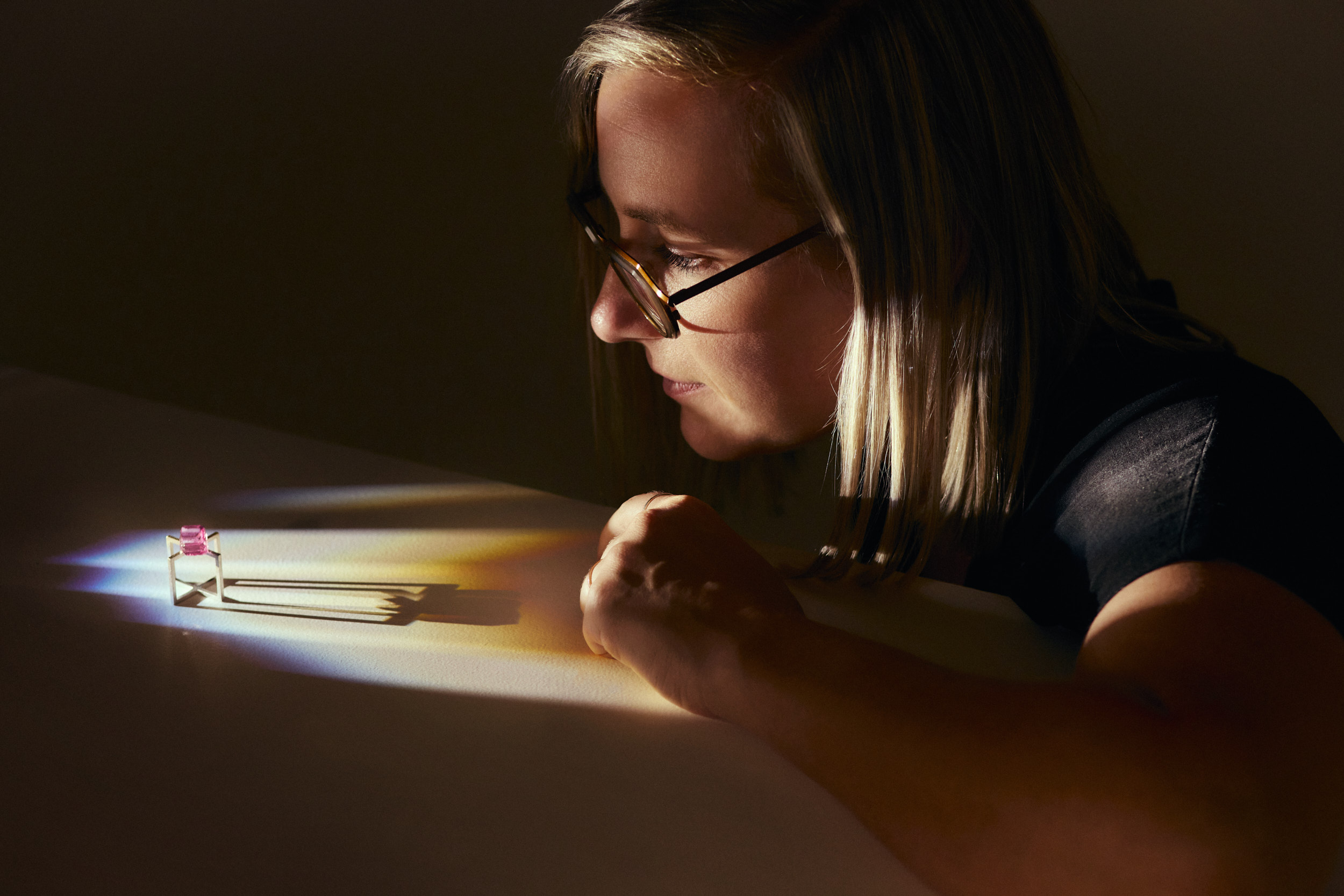
What happens when the precision of laboratory chemistry meets the tactile sensitivity of jewellery design? For researcher and artist Sofie Boons, the answer lies at the vibrant threshold where science, sustainability, and fine craft collide. Widely known across the contemporary art world as The Alchemical Jeweller, Boons deliberately challenges the rigid dogmas of traditional mining, proving that precious gems do not need to be violently extracted from the earth to hold genuine emotional and aesthetic value.
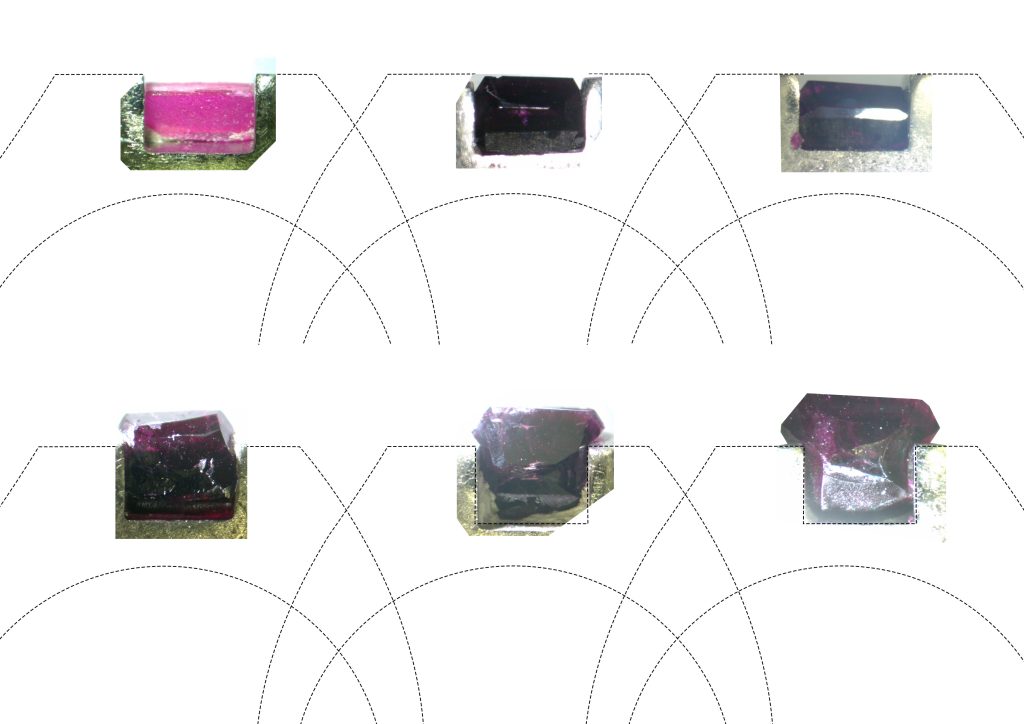
Through pioneering techniques such as in-situ crystal growth, cultivating rubies and sapphires directly onto sculpted metal frameworks, and the creative reclamation of discarded sapphire phone lenses and industrial diamond offcuts (urban mining), she turns material irregularity into a powerful ecological manifesto. Featured at Romanian Jewelry Week in the curated Growing Gems section, Sofie Boons invites us into an intimate, thought-provoking conversation on dismantling artificial rarity, collaborating with active matter, and reimagining the studio lab as a space of pure visual poetry.
Stepping into uncharted territory at the intersection of design and laboratory chemistry, two traditionally rigid fields, takes a great deal of courage. What did your early days as a woman artist and researcher look like? What prejudices or barriers did you encounter at the start?
I never set out with a plan to become „an artist” and then, separately, „a scientist.” Those labels are tidy in a way my actual path never was; the work simply demanded both of me, one discipline pulling me toward the other until the boundary between them stopped meaning very much.
I guess it all started with smell. First the smell of the jewellery workshop at the Royal Academy of arts. The first time I walked into the jewellery department there, the smell of it, the sound of it, something in me recognised the jewellery studio before I’d consciously chosen jewellery design as a career. My sensitivity to scent didn’t come from nowhere: I grew up around my father’s butcher shop, trained as a chef, he taught me to smell everything. That instinct followed me into the studio. I was as interested in how metals smelled as in how they looked, and the moment you start talking about scent and recipes, you’ve already crossed into chemistry. I guess that’s where it started.
I’ve never much respected that fence and collaboration became my way of working across it: with a glass blower, with a company producing nanoparticles, with scientists in Leuven on a project called Alter Nature, growing bacteria onto jewellery surfaces. Later, a „speed dating” event between artists and scientists at the RCA and Imperial College led to a collection that incorporated gold nanoparticles. Each collaboration taught me about how materials are approached in various disciplines, what vocabulary is used. They were a way in, and for a long time I told myself this was the only legitimate way to do it, because surely I wasn’t a scientist myself.
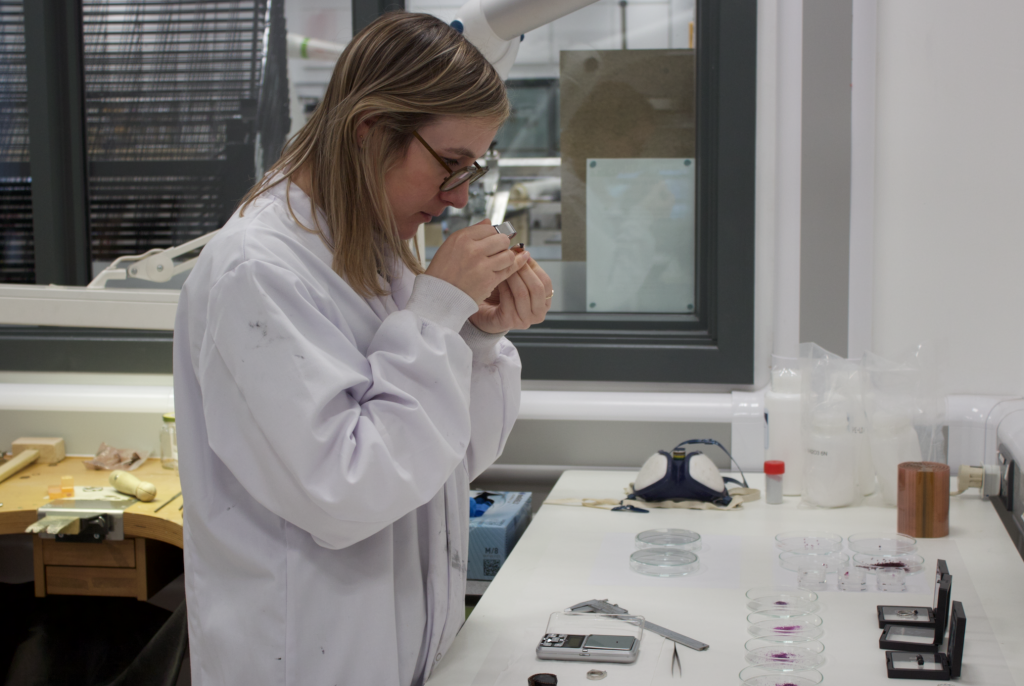
Then, for my PhD research, I focussed on crystal growth, and the collaborations that had always carried me became harder to lean on. COVID or the distance between myself and my collaborators made spending time in their labs nearly impossible. And when I did propose the ideas I actually wanted to pursue, to work with the crystal growing process itself, not handed finished materials by someone else, I met a bit of resistance: polite explanations of why that wasn’t really possible. This became a stimuli to jump disciplines, and attempt the chemistry myself.
So I taught myself. Not from textbooks, but at my kitchen table, jars of alum, sugar, salt, water, watching evaporation do its work, relearning by hand a process humanity has practised since the 1900s. Once I understood the underlying chemistry, I took what I’d taught myself into my PhD at UWE Bristol, supported by an extraordinary team at the Centre for Print Research, David Huson and Adrian Geisow among them. Where the pace of institutional collaboration felt too slow for the short, urgent span of a PhD, I started testing things myself, using a ceramics furnace that happened to be programmable. It turned out that crystal growth, for all its reputation as forbiddingly complex, opens up beautifully to craft and creative exploration once you understand its process.
That, really, is where the prejudice lived: the assumption that a jeweller makes things but doesn’t understand what she’s making them from. I hope I have proved my collaborators wrong. Anyone can understand chemistry if they’re willing to. And jewellers, makers, not just chemists in white coats, have real contributions to make to the field.
You often refer to yourself as „The Alchemical Jeweller.” How do the scientific rigor of the laboratory and the artistic sensitivity of jewelry design meet in your practice?
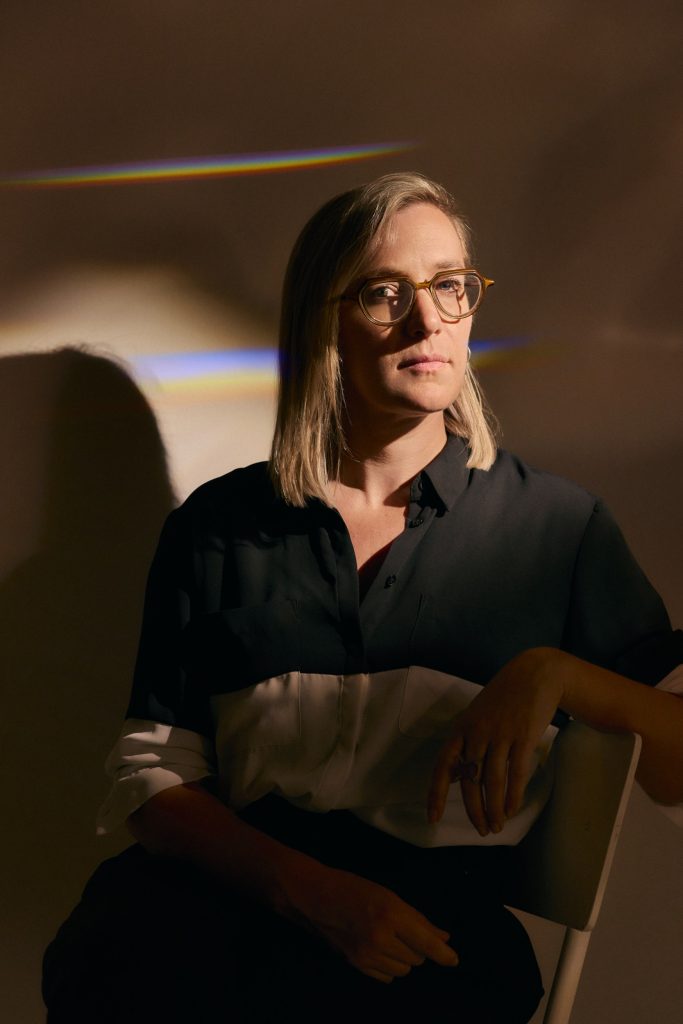
The name came from necessity, actually, before it came from meaning. At the Royal College of Art, during my master’s, my work was already quite conceptual and so spread across materials that it never resolved into one recognisable visual signature (though I think a thread runs through it all, if you look closely). My mentor asked me to find a title that could hold that breadth together. I looked at my bookshelf: the alchemy of gemstones, the alchemy of gold, the alchemy of scent. The Alchemical Jeweller. It just fit.
It was only later, reading more deeply into the history of alchemy, that I realised how much more the title had given me than I understood at the time. Alchemical laboratories were, in a real sense, hotspots for various disciplines. In places like the Netherlands, jewellers and metalworkers worked in close proximity with the earliest chemists. The line between disciplines simply hadn’t hardened yet. Alchemists carry a slightly disreputable reputation now, painted as men chasing the re-creation of gold, tinged with something like cheating, which I find fascinating given how closely that mirrors the suspicion still aimed at lab-grown gemstones today. But what actually defined their practice was the fusion of reading and theory with hands on experiment, hypothesis and making moving together rather than in sequence. That, to me, is a precise description of how I work.
On rigour specifically: the kind of scientific rigour expected in laboratories today can be genuinely limiting for an artist. We often think differently about failure.
Artists are happier simply to try something, even when it looks unlikely to work on paper, and we tend to value the failed experiment as much as the successful one, sometimes more, because of what it reveals.
Some scientists work this way too, but it isn’t the norm, and the expectation of full replicability, of never moving forward until you can explain exactly what happened, is where I think artistic freedom offers something science often can’t. It lets you move at speed: testing before the hypothesis is fully proven on paper, finding real joy in what goes wrong.
So while I do aim to work transdisciplinarily, applying both scientific and artistic methods, the one trap I actively avoid is unnecessary rigour. Not everything needs to be explained. There is magic in experimenting, and documenting every variable to the standard science expects would cost me too much time and freedom. The artistic approach to science, for me, is the freedom to follow your interests rather than a predetermined protocol. And it’s about aesthetics too. Alchemists wanted to make beautiful things. However committed I am to sustainability, to processes that support localised, sustainable production, I still care enormously about the crafted object: the well made piece, the aesthetically resolved piece, a strong concept given the material form it actually deserves. Maybe that is where I apply rigour instead.
Jewelry has always been associated with rarity and traditional mining. What made you challenge these rules and explore lab-grown crystals?
It all started from a chance encounter during a project I set up and secured Erasmus funding for, bringing together three institutions, Alchimia, Trier University of Applied Sciences, and the British Academy of Jewellery, where I was representing BAJ. As part of that project, in 2017, we visited a crystal growth factory in Germany, a visit organised by Julia Wild. That single visit changed everything.
The company wasn’t growing crystals for jewellery at all; their crystals were destined for laser and industrial applications. I stood there holding an enormous crystal and realised how little I actually understood about how crystals are grown. What troubled me more was recognising that as a jewellery educator, I had been unconsciously repeating a narrative I’d never questioned: describing lab grown materials as fake, as lesser than mined stones, simply because that was the language the industry had handed me. Standing in that factory, with my existing interest in materials and in dissolving disciplinary boundaries, I remember thinking, if we can grow crystals like this, I want to try it.

It took several more years before I could properly investigate it, through my PhD at the Center for Print Research. Once I started digging into the history, visiting an archive in Idar Oberstein, reading old gemological texts, a much fuller picture emerged. Crystal growth became commercially viable in the late nineteenth and early twentieth centuries. Controlled by chemists and scientists, there was an intent to try and recreate what nature makes, then supply it onward to jewellers. Jewellers themselves were barely involved in shaping the technology and the industry’s general position, in what I’d paraphrase from that early literature, was one of protecting the value of mined stones, a value built on rarity, even though we know that rarity, particularly for diamonds, has long been artificially controlled. Some of the earliest gemology books actually describe crystal growing techniques using the language of weaponry. Fake. Imitation. A whole vocabulary and set of expectations that jewellers like me absorbed without even fully realizing.
I don’t like discovering I’ve been shaped by a narrative I never consciously agreed to. And once I started thinking seriously about sustainability and about how little agency jewellers actually hold in this conversation, that discomfort sharpened into something more urgent. Right now the choices are genuinely poor. You can buy a lab grown stone, almost certainly produced abroad, grown from scratch using significant amounts of electricity, under labour conditions that are rarely made transparent, and standardised to imitate its mined counterpart as closely as possible rather than offering anything new. Or you can buy a mined stone, knowing that roughly eighty percent of coloured gemstones are still extracted by artisanal miners using rudimentary tools, often in dangerous conditions. Neither of these are particularly great options..
What genuinely excites me is the possibility of growing crystals from recycled crystal waste, chipped stones, the sapphire lenses inside phone cameras, material that already exists and would otherwise be discarded. When jewellers can grow from that waste stream directly, we’d finally have agency: control over the conditions we grow in, growing only what we need, when we need it, where we need it, with room to be genuinely creative with the technique itself. That’s what challenging rarity and traditional mining actually means to me.
Not chasing an imitation, not producing a copy of something nature already does better, but treating crystal growth as its own technology, capable of offering creative, crafted solutions that neither mining nor conventional lab growth currently make possible.
One of your most fascinating innovations is growing rubies and sapphires directly in and on the surface of metallic structures (in-situ), allowing time, the environment, and material behavior to shape the final piece. What does a day in your laboratory look like?
The most exciting days look something like this. My research associate, Milly Hardy, and I plan an experiment together and set it up: choosing the metal, the chemistry, the conditions we want to test. Then comes the waiting, growth cycles typically run somewhere between five and fifty hours, and there’s a real anticipation in that gap. When the cycle finishes, we harvest, clean, and review what’s happened. That moment, walking into the space and finding out what the growth has actually done, is genuinely the most exciting part of the work.
But that’s not really what most days look like, and I think it’s worth being honest about that. The rest of the time, and there’s a lot of it, goes into things that have nothing to do with crystal growth at all: applying for funding, writing reports, documenting process, communicating with stakeholders/ institutions. Working within an academic, non-commercial context gives me freedom from having to produce things purely to sell, which matters enormously to how I can experiment. But it comes with its own cost. Precious metals aren’t cheap, platinum least of all, and craft research in the current funding climate is chronically undervalued compared to other disciplines. So a lot of what actually fills my days is the unglamorous work of trying to secure the resources to make the exciting days possible at all, and challenging that imbalance in how craft and creative innovation get valued is something I take on quite deliberately, not just as a frustration to work around.

Also, I conduct my research at the Center for Print Research (University of the West of England), and I’ll admit I have some reservations about the word „laboratory” itself. There is real scientific infrastructure there, fume cupboards, tools for measuring and storing chemical components safely, everything you’d need to run something that could genuinely be classed as a chemistry experiment. But my jewellery bench sits in close proximity to that equipment, surrounded by artists and craft practitioners who are all crossing disciplinary lines and using that same equipment in artistic, exploratory ways. So I think of the space less as a laboratory and more as a hybrid studio lab, and the closeness between where I grow the crystals and where I actually make the jewellery is one of the real advantages of working there.
Traditional jewelry making requires millimeter-precise control over every single facet. In your case, what percentage of the final result is meticulously planned by you, and how much is the unpredictable reaction taking place in the lab?
It’s genuinely hard to put a number on it, and I think that’s rather the point.
My training as a jeweller taught me to be an actor upon inert matter: you decide the angle, you cut the facet, the material does what your hand and your tools tell it to do, at least, to a great extent.
Crystal growth by evaporation doesn’t necessarily lend itself to this approach, and it took me a while to stop wanting it to.A crystal isn’t alive in any conventional sense, but it does grow, and it follows its own rules, rules dictated by chemistry and by nature.
Drawing on Karen Barad’s idea of agential realism, I think of making, in this context, as an intra-active process: my intentions, my tools, and the material itself co-constitute the outcome together. I’m not shaping something passive. I’m a participant inside a dynamic ecology of crystal behaviour and timing. I plant a seed, I tend the growth, and I harvest what emerges from that entanglement of what I know, what conditions I set, and what the material itself asserts. When crystals grow in-situ within or around a metal structure, they form naturally oriented facets and spontaneous nucleations that settle into the metal’s own grain boundaries, and in that moment both metal and mineral are visibly asserting their own history, their own trajectory. Neither one is simply obeying me.
So yes, there’s real planning involved, and I go quite far with it: choosing seed placement, temperature, timing, the specific chemistry of a batch. I’m also a trained facetter, so if I wanted every stone cut to a standard, optimised form, I could do that in post production, the same way a mined stone would be cut. But increasingly, that’s not where the interest lies for me. Optimising light return through a perfectly symmetrical cut only holds my attention for so long. What genuinely excites me is growing in and around existing structures, building bespoke inclusions, growing colour on colour, taking control of a process by collaborating with it rather than overriding it.
There’s another layer to this too. Because I’m growing from waste, from urban mined material, chipped stones, camera lenses, material with its own prior life, I have to respond to what that material already is and has already been. Some people might see that as a limitation. I see it as a brief, and a genuinely generative one. It’s not realistic, in a sustainable future, to expect an endless supply of virgin material waiting to be shaped into something perfect.
So I’d rather ask where the beauty is in the unexpected, in the irregular, in the unique result that only this particular seed, this particular metal, this particular set of conditions could have produced.
I can plan the conditions. I can’t, and don’t really want to, plan the outcome entirely. Sowing the seed and seeing what comes of it is the part I’ve grown to value most.
From features on BBC News to your role as a Visiting Research Fellow at the Royal College of Art and the inclusion of your pieces in major international collections, your work has received remarkable recognition. How does this validation of such an unconventional and bold path feel from within?
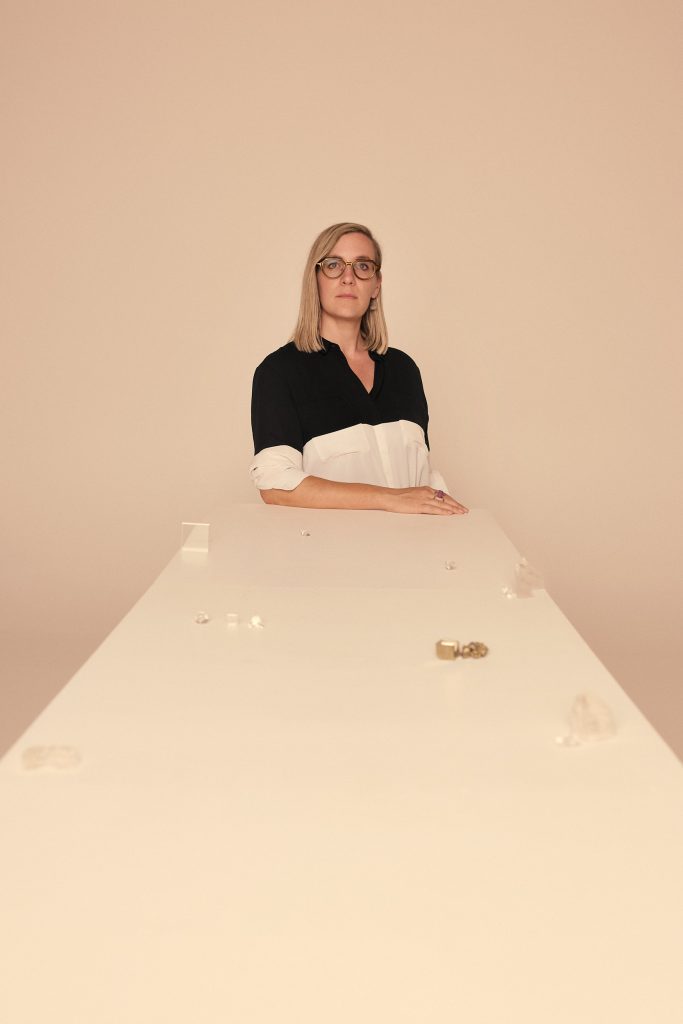
Honestly, I often cannot quite believe it myself. A PhD is four years of intense, often quite isolated work; you’re collaborating, but there’s still a solitary core to it, hours of testing and failing and trying again with no guarantee any of it will land anywhere. So any validation after that, whether it’s a BBC feature, or a piece entering a collection, does feel genuinely amazing.
But I’d be doing the question a disservice if I left it there, because lab-grown gemstones remain a contested subject, and greater visibility has brought greater challenge to my work with it. This pushback, much of it inherited from the wider suspicion the jewellery industry has always directed at lab grown gemstones generally, can be quite hard to deal with. If you’re trying to give agency to jewellers and makers, you’re implicitly taking some agency away from actors who currently hold it, and that was never going to be universally welcomed.What I value most, from the inside, however, is connecting with people who share this appetite for creativity and for pushing past disciplinary boundaries, people who find their way to the work precisely because it’s become more visible. That part is genuinely rewarding.
I never set out to do any of this for recognition; the work has always come first. But I won’t pretend recognition is easy to be indifferent to once it arrives, and I’ve come to think it actually matters for reasons bigger than me.
If jewellers are ever going to have the option to grow their own gemstones, the wider public, the people who actually buy jewellery, need to stop seeing grown material as lesser or fake, the way I once unconsciously did myself. And the industry voices pushing this narrative forward need an audience that’s genuinely receptive to it, one that values working with waste, that finds real appeal in uniqueness over uniformity. That’s how a market gets built, and how more space opens up for makers who want to work this way.
So from within, it feels like I’m moving in the right direction, but I want to be honest that it isn’t always a comfortable position to hold.
Being a trailblazer is considerably harder than staying a quiet, invisible experimenter in the background.
But I’m genuinely committed to using whatever platform I’m given, at every stage, to try to build a better future for creativity, for jewellers, for the industry as a whole. That’s precisely why I chose academia in the first place.
As a lecturer and mentor, you are in direct contact with the next generation of makers. How do you perceive the energy, curiosity, and values of the young creatives entering the field today, and what is that one universal piece of advice, beyond techniques or materials, that you hope they will always carry with them?
The students entering the field now are walking into a genuinely difficult context, and I don’t think it does them any favours to pretend otherwise. The world they’re graduating into is changing faster than the one I trained in, and it’s more challenging in almost every respect: economically, environmentally, ethically. What I find remarkable, though, is how willingly they take that on. I recently watched a graduating cohort take on themes like objectification, mortality, consumerism, remembrance, grief, real, weighty subjects, without flinching from them. They stayed with the trouble, rather than looking away from it, and the work for it was stronger.
My advice to them is to stay awake. To really open their eyes to the fact that so much of what surrounds us, the systems, the hierarchies, the assumptions about value and rarity I spoke about earlier, are human constructs, built by people, and precisely because they were built, they can be rebuilt.
Creativity and making aren’t decorative activities sitting outside that work; I think they’re genuinely central to solving the problems we’ve made for ourselves.
I also push back, quite deliberately, against the model of the solitary genius maker that so much of art education still prescribes. I want my students to collaborate, to connect, to resist the instinct to do everything alone, because I don’t think that instinct serves them. Jewellery, is relational and temporal:and if students understand jewellery that way from the start, as something that acts in and on the world rather than something simply finished and displayed, I think they carry something much more durable than any single technique.
So, I always say to students, craft your path, don’t forget to care, about the materials, about each other, about the world you’re making things for. Solid footing and real networks, not solitary brilliance, are what sustain a practice long after graduation.
At Romanian Jewelry Week, you are part of the Growing Gems section. What message does the curated body of work you are presenting at this edition convey?
What I’m bringing to Bucharest is work that spans my PhD research through to what I’m making right now, and together I hope the pieces will make the case that crystal growth belongs in the hands of jewellers, not only in industrial or scientific labs.
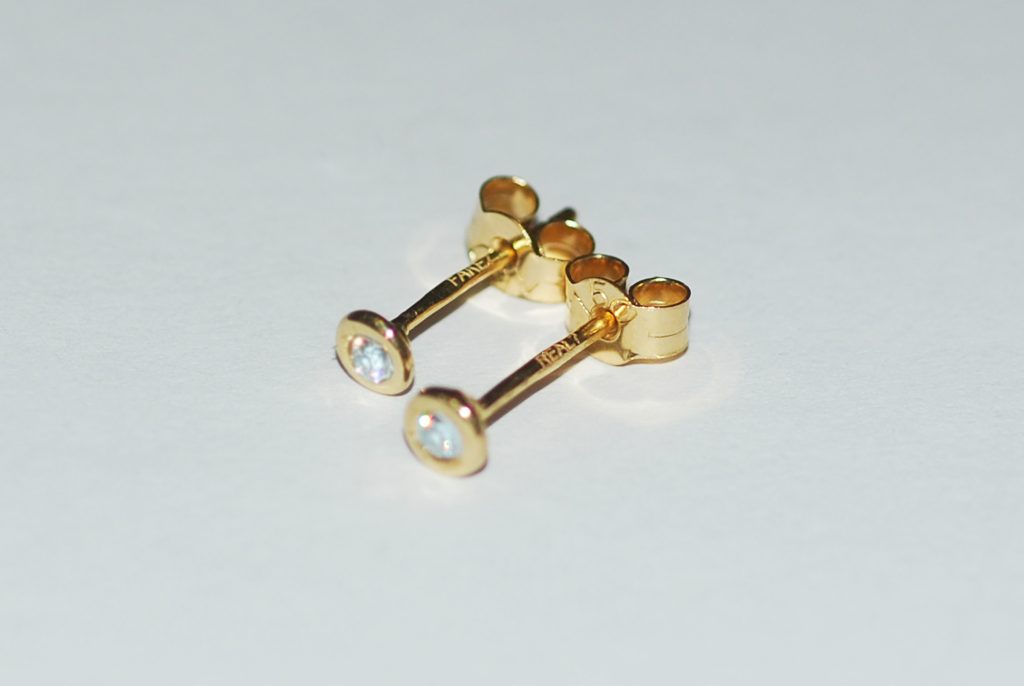
The first strand of work are the pieces created with crystals retrieved through urban mining. Carbon Shimmers is made from urban mined CVD diamond offcuts, material discarded from industrial growth processes and taken up here not despite its waste origins but because of what those origins reveal: unexpected, almost celestial patterns that use the residue of the technology itself to demonstrate its beauty. These pieces draw directly on that discarded material as inspiration, incorporating its prior life and its imperfections into the jewellery itself, rather than starting the story over from a blank, virgin stone.
The second strand of work is the result of a collaboration with BREVALOR: pieces made using the world’s first photoluminescent single crystal gemstone material, BRG, which let me experiment with something I find genuinely thrilling, sculpting light itself rather than only form. Those pieces have two identities, one by day and an entirely different one after dark, which means the design decision isn’t only about the material you can touch, it’s about designing what the piece emits.
And the third strand is the rubies and sapphires I’ve grown myself, in-situ, in the hybrid studio lab where I work, pieces that carry the naturally oriented facets and spontaneous nucleations that only this particular process, this particular collaboration between metal and mineral, could have produced.
The message underneath all this work, I hope, is an invitation rather than a statement: come and look closely.
These pieces are so much more beautiful in person than in any photograph, because so much of what makes them interesting, the way facets catch differently depending on how a crystal actually grew, the small unrepeatable irregularities where the material asserted itself against my plan, simply doesn’t translate to an image.
I’d love for visitors in Bucharest to stand close, to try and count the „disobediences,” the little unplanned deviations scattered through the work, and in doing that, start to reconsider what value in a gemstone could mean beyond rarity and perfect symmetry.
That reconsideration, more than any single piece, is really what Growing Gems is about for me.
How do you view the role of events like ROJW in educating the wider public and promoting jewelry as a form of conceptual art and a manifesto for sustainability?
Events like this matter more than we would probably like to admit to ourselves, because the jewellery world can also be a genuine bubble. Talk to enough jewellery artists and curators and you start to believe everyone understands the world the way you do, that concepts like material agency are self-evident. They aren’t, not to a general public, and unless events like Romanian Jewellery Week deliberately create space for work to be shown to a non specialist audience, people who haven’t been trained to read pieces in the way we do, the discipline stays isolated from exactly the conversations it needs to be part of.
I think of jewellery as a mirror of the society that makes it. It has never been just a discrete, resolved object sitting still in a display case; it’s relational and temporal, it moves with the person wearing it, it can shift how someone carries themselves, how a dancer moves, how someone relates to memory or to the future.
Understood that way, jewellery has real things to say about consumerism, about extraction, about care, about what we choose to value and why, and those are exactly the questions a sustainability conversation needs voices in. But none of that lands if the only people encountering the work already speak the discipline’s internal shorthand.
So events like ROJW carry a real responsibility, and an opportunity, to position jewellery as conceptual art with its own legitimate methods of thinking and making, not decoration sitting apart from bigger cultural questions, but a discipline entangled with them. That has to be communicated with genuine care, not dumbed down, but translated generously, so a visitor with no background in the field can still stand in front of a piece and feel something of what it’s actually asking. Breaking down that isolation, connecting jewellery to the wider world rather than keeping it inside its own bubble, is precisely the disciplinary boundary breaking I’ve tried to practise throughout my own work. Seeing an event built around doing that at scale is genuinely exciting to me.
What do you hope a visitor stops, feels, or discovers when standing in front of your pieces in Bucharest?
I’d love, more than anything, for someone to simply slow down in front of the work. Not a quick glance and a verdict, but a pause long enough to notice the small unrepeatable things: a facet that caught the light in a way no cutting decision produced, an irregularity that tells you the material had its own say in how the piece turned out.
What I’d really hope someone discovers, in that pause, is a quiet reconsideration of where value in a gemstone actually comes from. Most of us, myself included once, were taught without ever quite realising it that value means rarity, symmetry, a stone behaving exactly as convention expects. I want a visitor to stand in front of a piece that was grown demonstrating a novel property, or grew somewhere unexpected, or carries the memory of material it used to be, and feel curious rather than suspicious about that. To find the irregular beautiful rather than lesser.

Autor: Sânziana Fărăgău - Dragoș
Sânziana Fărăgău - Dragoș își găsește echilibrul în sala de sport, iubește timpul petrecut cu prietenii și vacanțele care îi aduc inspirație. Cei care o cunosc spun despre ea că pune suflet în tot ceea ce face, fiind perseverentă și ambițioasă, mereu în căutare de noi provocări și oportunități de creștere. Scrisul este pentru ea o sursă de creativitate și un mod de a se exprima liber.
You may also like
Romanian Jewelry Week 2026: Peste 300 de Designeri la Biblioteca Națională
Între 30 septembrie și 4 octombrie 2026, peste 300 de designeri din mai mult de 50 de țări vor d

Claudia Pușcașiu, fondatoarea SAKRA: „Mă interesează acea calitate a execuției care nu are nevoie să iasă în evidență, dar pe care o simți atunci când privești și porți bijuteria”
Claudia Pușcașiu este fondatoarea SAKRA, un brand de bijuterie contemporană născut la intersecț

Romanian Jewelry Week 2026: Peste 6.000 de Vizitatori și Câștigătorii Ediției VII
S-a încheiat cea de-a șaptea ediție Romanian Jewelry Week, cel mai important eveniment dedicat bi
