

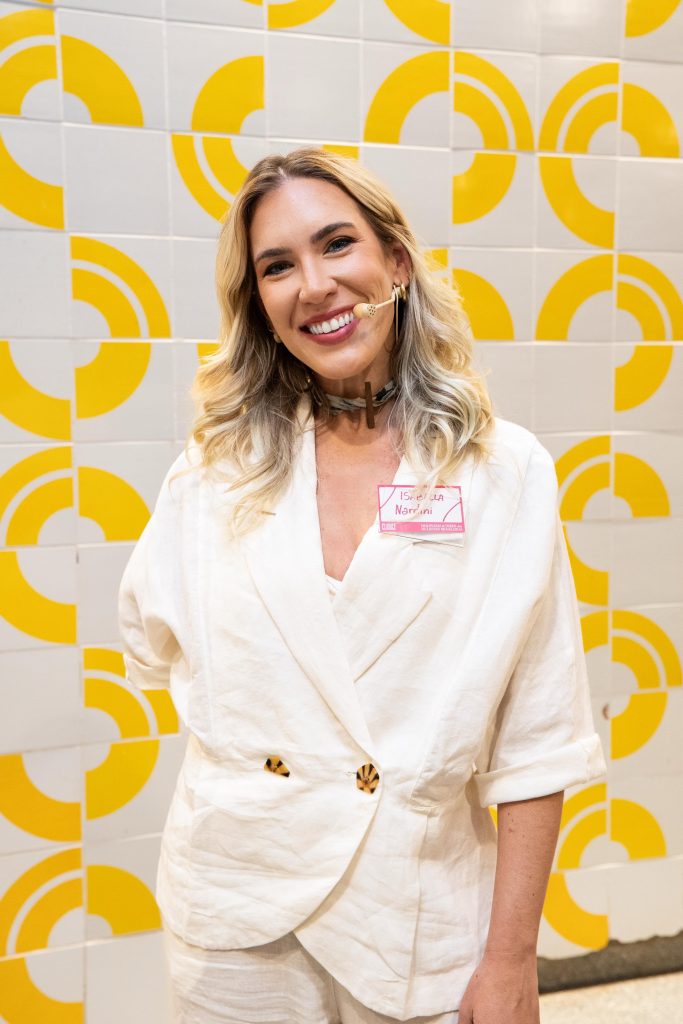
Isabella Nardini, artist & experience designer: „space is not simply where an experience happens. Space is one of the things making it happen”
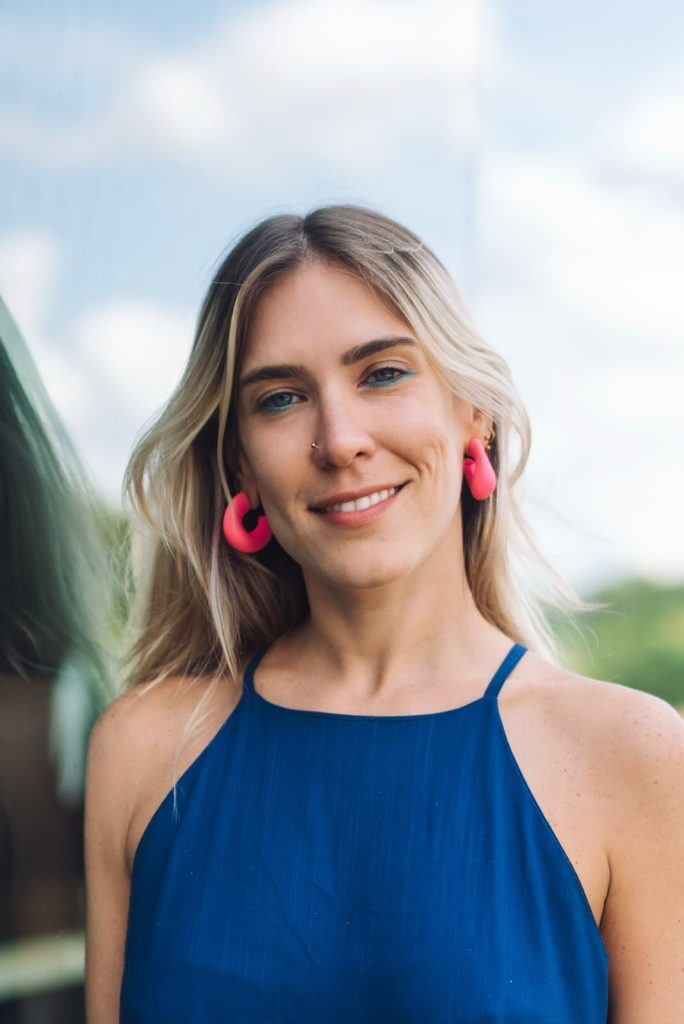
Isabella Nardini is a Brazilian artist and experience designer whose practice explores participation as an artistic medium. Working across performance, rituals, walking experiences and relational installations, she investigates how small shifts in the forms of encounter can interrupt everyday automatisms and open space for presence, imagination and collective meaning. Alongside her artistic practice, she has designed large-scale participatory experiences for cultural institutions and global organizations, bringing the same research into museums, festivals, companies and public spaces across different countries.
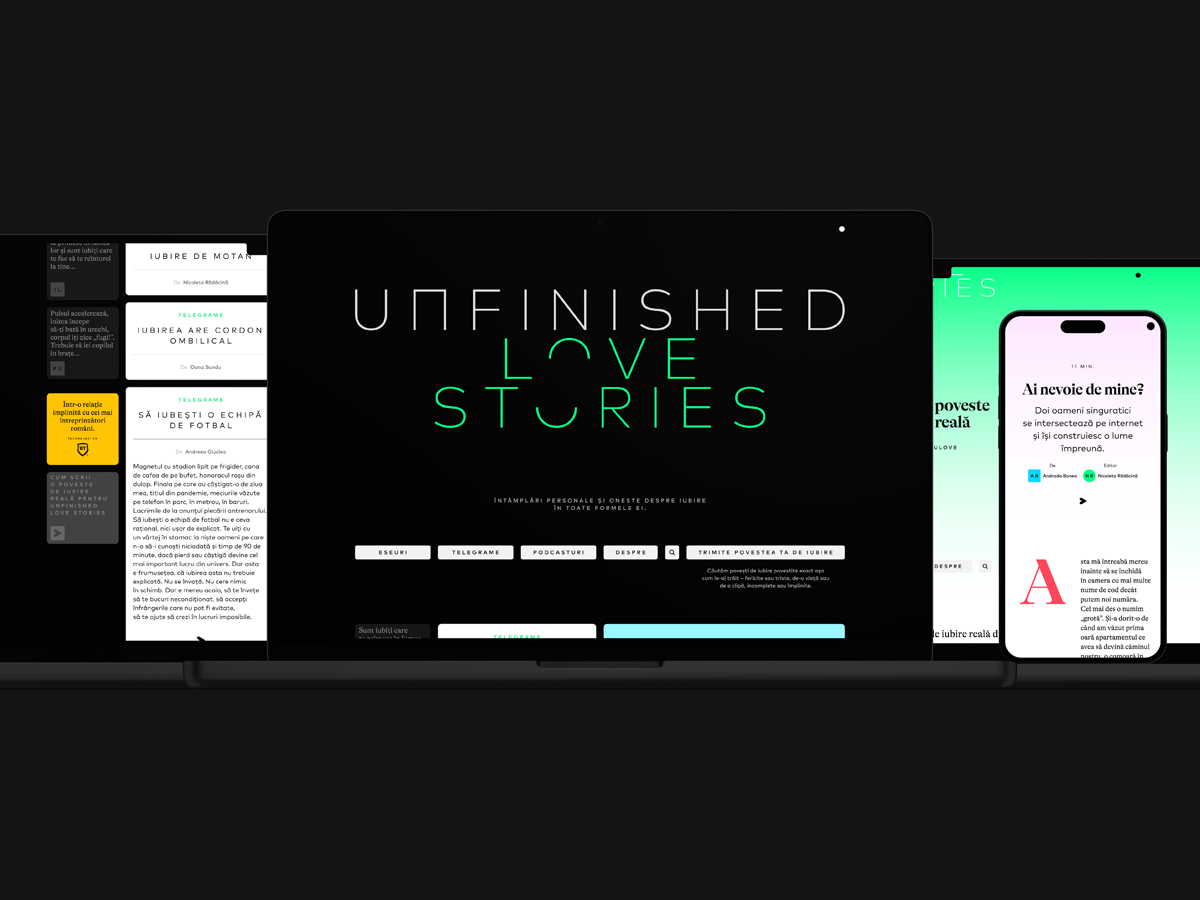
This year, Isabella was part of the experience of the multidisciplinary UNFINISHED festival, held in Bucharest from September 25 to 27. Rather than making a traditional appearance on stage, she brought participatory experiences and relational objects to the festival, built around human connection, vulnerability, and the things that can happen when we do not know in advance what the other person will bring into a shared space. For Isabella, the encounter is not only the subject of the work, but the material from which it is made.
Your professional journey began in design and, over time, expanded into art, object design, and experiences created for people. For THE WOMAN readers who are discovering your work for the first time, how would you describe the path that took you from design and art toward this interest in human experiences?
I’m not sure I moved from design and art towards human experience.
I think human relationships were the question from the beginning, and design and art became different ways of entering it.
The most honest answer is that human relationships terrify me. When something depends only on me, I can usually find a way through it: I observe, learn, try again. But when another person appears, I lose that certainty. I don’t know what they will understand, want, refuse or change. I no longer know exactly what I am doing.
At the same time, I have always been fascinated by what becomes possible between people. When I was fourteen, I went alone to my first large concert. The curtains opened and hundreds of people screamed at exactly the same time, as if they had rehearsed it. Gradually, all those separate bodies became one body—jumping, singing and sweating together. Then the lights came on, and that body dissolved back into individuals.
I remember thinking: this is what I want to create for people. Of course, this is a fourteen-year-old girl’s memory being interpreted by a thirty-seven-year-old woman, but the sensation remains very precise.
That is probably why I make this work. I create forms—a chair, a walk, a question, a ritual—that give me something to hold while I enter the place where I feel most disoriented, but also most alive: the relationship with another person.
Today, these different forms come together in Belleza<Belleza, the studio I founded for bespoke, authored experiences. Through it, I create encounters, rituals, journeys and objects for cultural institutions and organisations. It is where my artistic practice and commissioned work meet—not because they are the same, but because both begin with the same question: how can a carefully constructed situation change the way people perceive, behave and relate?

Your background includes graphic design, product design, and jewelry, and early in your career you worked as a jewelry designer and had your own brand in Italy. What drew you to objects at that time, and when did you begin to feel that what truly interested you lay beyond the object itself?
At university, I studied both graphic and product design because I couldn’t choose between them (not to mention that I nearly went to university to study tourism and hospitality!). For my final project, I was expected to choose again. Instead, I began spending afternoons in the workshop, watching people build furniture, cutlery and car prototypes.
One day, I noticed scraps of coloured resin on the floor. A fragment with a hole through it immediately looked like a ring and reminded me of the paper rings my grandmother made for me as a child. So I carved it into one.
That became the beginning of FLOW, my handmade resin jewellery brand, which I created in Brazil before moving to Italy. I was interested in the possibility that something discarded on the floor could become precious—not because its material had changed, but because our relationship to it had.
Objects have accompanied human beings for as long as we have existed. They carry our gestures, mark transitions, reveal belonging and remain after moments have ended. Even then, I think I was less interested in the isolated object than in the meaning created around it: the person who chooses it, the body that wears it, the story it begins to hold.
Later, while working in an office in Florence designing jewellery, I understood more clearly that the object alone was not enough for me. What interested me was the object in relation—to a body, a space, a memory, another person.
Years later, that question brought me back to objects through relational furniture. I never really left the object. I needed to understand that an object could contain a human situation.
You lived in Italy for a period of time and were exposed to contexts such as Milan Design Week and the Venice Biennale. How did those years influence the way you think about design and the relationship between art, space, and the public?
I lived in Italy from 2013 to 2015, spending time between Florence, Milan and Venice. I also managed Maison 203’s participation in Milan Design Week and a pop-up in Venice during the Biennale (Maison 203 created jewellery using 3D printing and hand-finishing, bringing technology and craftsmanship together).
What affected me most was not a particular object or exhibition. It was seeing entire cities behave differently. (I think I’m obsessed with finding new ways of existing because existing itself can be so difficult.)
During Milan Design Week, public space was temporarily overtaken by creation. People walked without their usual destinations, entered unfamiliar buildings and allowed curiosity to reorganise their days. I began to understand the importance of occupying public space not only physically, but imaginatively: temporarily changing what a city permits people to do and how it allows them to behave.
Venice taught me something different. With no cars or bicycles allowed, distance becomes physical. Meeting a friend may require walking for fifty-five minutes. That changes your relationship with effort, time, choice and your own body. The Biennale’s pavilions transported me into distinct universes, but Venice itself may have been the strongest installation.
I began to understand that space is not simply where an experience happens. Space is one of the things making it happen. A city can change how fast we move, where we look, what we consider possible and whom we become available to notice. That understanding still shapes the way I create today.

In 2015, you joined MESA, where you eventually became Global Head of Experience. Your work involved objects, scenography, rituals, and interaction frameworks, all designed to influence the way people work together. What did you learn about human behavior from observing so many teams working under conditions of pressure and intense creativity?
I learned that absolutely everything influences how people behave together: the height of a table, who enters first, where an object is placed, whether there is music or silence, whether the room feels cared for or improvised. Under pressure, these details become even more visible.
At MESA, I became interested in rituals rather than rules. A rule tells you what is permitted. A ritual marks a crossing. When you enter a church, a museum or a theatre, your body often understands that another kind of behaviour is expected before anyone explains it.
I wanted to understand how an experience could create that threshold for a group under pressure: a temporary world with its own time, gestures and agreements.
But people are not predictable material. They resist, misunderstand, interrupt and surprise. Over time, I stopped treating that gap as a failure of design. It is where the structure encounters an actual human being—and therefore where the experience begins.
(It is important to say that I did not discover this by reading books about rituals. The process was quite intuitive and empirical: noticing myself in order to try to perceive another person, and becoming slightly obsessed with details.)
I also began to understand an experience as a sequence. What seduces someone into entering? How does it begin? When does something shift? What are they actually invited to do? How does it end? What remains afterwards?
MESA was an important part of my formation, but it belongs to an earlier chapter of my practice. Years later, through Belleza<Belleza, I developed these observations into my own six-part methodology, which I now use across my artistic and professional work: The Seduction, The Start, The Shift, The Action, The Closure and The Memory.
You have worked across very different contexts, with organizations and professionals from a wide range of fields. After dozens of projects like these, have you begun to identify certain things that help people become more creative or collaborate more effectively? What tends to remain consistent, regardless of culture or industry?
Three things remain consistent for me: form is never neutral, participation begins when what is happening genuinely needs you, and creativity requires both structure and room to interfere.
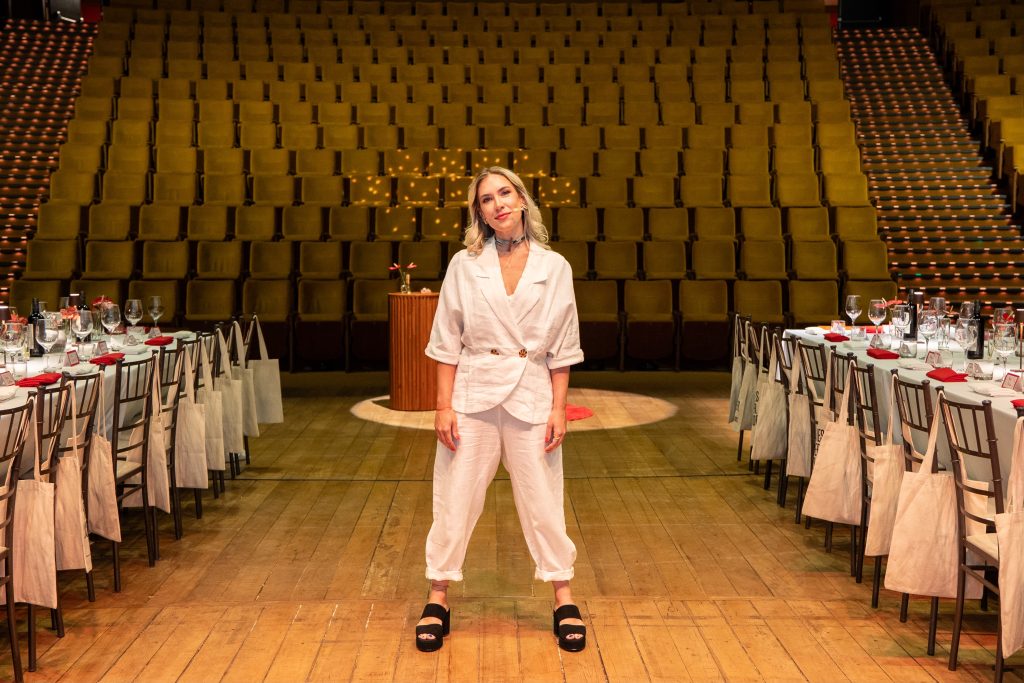
In one work, ninety women occupied a single table on a remarkable theatre stage in São Paulo—a space normally reserved for those who perform while everyone else watches. The experience investigated women’s imaginaries of power: which images of power we have inherited, which ones we reproduce and which ones we might invent together. Placing a shared table on the stage disrupted its usual hierarchy. There was no longer a clear division between spectacle and audience. The women themselves became the image, the gathering and the event.
In another, Instructions for a Shared Dessert, I created a metre-long cake to be eaten collectively, with spoons directly from the cake. The dessert could not fully exist for an individual. Its form required people to negotiate distance, rhythm, waiting, offering and sharing. The object was incomplete without the relation.
Form quietly tells us what our role is and influences how we relate. A long table establishes one relationship; a circle produces another. Walking beside someone creates a different conversation from sitting across from them. Writing before speaking changes who is heard.
Creativity does not necessarily emerge because we tell people to be creative. It appears when the form changes the behaviours available to us—when there is enough structure for people to enter and enough openness for them to alter what happens.
In the way you talk about creativity, the ideas of inventing, finding new solutions, and remaining curious come up repeatedly. How do you preserve your own curiosity in a profession where you are often the person responsible for creating the conditions for others to explore and experiment?
I preserve my curiosity by creating—and accepting—projects for which I do not already know the answer. Some begin with a challenge brought to me by an organisation or institution. Others begin with a question I cannot stop thinking about, so I create a work in order to investigate it. Both require me not to turn my own practice into a formula.
Every context produces a different equation. Who is here? Where are we? What does this place already mean? What can happen here that could not happen somewhere else? I can repeat the structure of a work, but I do not believe in installing it unchanged. There is always a new element in the equation, and the more seriously I consider it, the greater the chance of creating something meaningful for the people who will experience it.
In 2026, that equation became Confessonhário, or Dreams Out Loud, at Theatro Municipal de São Paulo. In the work, people confess their waking dreams to strangers; those dreams are written down, placed in a box, mixed together and later given new voices. That day, 108 people lay on the stage confessing their dreams. People who would normally occupy seats in the audience found themselves barefoot and horizontal beneath the theatre’s painted ceiling—a place many artists have to dream very big even to imagine standing on one day.
Afterwards, one woman left crying. She told me she was not crying because of the dream she had confessed or the one she had heard. She was crying because she had realised she had never spoken her dreams out loud before.
Until then, I had not fully understood the gravity—in the gravitational sense—of saying a dream aloud. Sometimes the work reveals its meaning to me through what another person discovers inside it.
That is how I preserve my curiosity: by creating situations that can still teach me something. I do not want to arrive with an answer ready to install.
I want to discover what this place, these people and this moment make possible—and what they might allow me to risk or understand for the first time.
Love Is In The Cloud emerged in the early days of the pandemic, at a time when people’s physical worlds had suddenly become much smaller. You started from the need to bring back the element of surprise and the emotions associated with meeting someone new. Do you remember the moment when you realized that this idea could become a project?
Yes and no. I remember the moment the impulse appeared, but I did not immediately understand it as a project.
I was in a Zoom meeting with alumni from a course I had taken, and at some point we were divided into breakout rooms. Suddenly, I felt butterflies in my stomach and thought: Oh, who is going to be on the other side? Who am I going to talk to?
I noticed that unexpected feeling—would I have felt it so intensely if we had not been in the pandemic?—and immediately wanted to turn it into something other people could feel too. I found myself alone with someone I did not know, inside a tool associated mainly with work, obligation and exhaustion. I wondered whether that little digital room could become something else.
Could it recover the nervousness of meeting a stranger? Could the same screen that was flattening our lives introduce unpredictability again?
Love Is In The Cloud began as an attempt to respond to those questions. It was closer to a participatory experiment than to a business idea. I did not want to create a dating platform or a solution for loneliness. I wanted to create a small openi
In its online format, Love Is In The Cloud brought together strangers who had never met before and guided them through a series of conversations and rituals. How did you design the structure of these encounters, and to what extent do you think intimacy between two people can actually be designed?
I don’t think intimacy itself can be designed. The moment I claim to produce it, I remove the uncertainty that makes it possible.
What I can design are conditions: how two people arrive, how much they know about each other, the duration of the encounter, the progression of gestures and questions, and the alternation between speaking and listening.
In Love Is In The Cloud, participants entered without photographs, profiles or compatibility filters. The structure needed to be precise because the outcome could not be. It offered enough form for people not to feel abandoned, but enough openness for something unplanned to emerge.
I can invite vulnerability, but I cannot demand it. A genuine invitation must contain the possibility of yes, no or maybe. Otherwise, it is an instruction disguised as participation.
For some interval of time, two strangers agree not to know what the encounter will become. Sustaining that not-knowing may be one of the conditions of intimacy.
I design the situation. The encounter belongs to them.
An important part of the project was the absence of algorithmic filters and the usual criteria we rely on when deciding whom we want to connect with. At a time when digital platforms constantly recommend people, products, and experiences based on similarities, what do you think we lose when encounters with others become too predictable?
When encounters become too predictable, I think we lose more than surprise. We lose practice in meeting what we did not choose—and in remaining when we cannot anticipate the outcome.
I understood this more clearly when I was invited to create a performance, an experience—whatever I wanted—at HackTown, a Brazilian festival of innovation, technology and encounters that takes place in Santa Rita do Sapucaí, a small town in Minas Gerais. Before deciding what I could create there, I asked the festival’s founder to tell me about the town and why the festival existed.
She told me that part of the town’s sense of well-being came from the unplanned encounters that still happened on its pavements. You leave home to buy bread, meet someone you did not expect, stop to talk, and return home in a different mood. These small, unscheduled encounters accumulate. Day by day, they change how people experience the town and one another.
I wanted to recover and experiment with that possibility. What would I encounter if I made myself available to what I could not predict?
So I designed a wooden chair specifically for the performance: two seats facing opposite directions, with low backrests that allowed two strangers’ backs to touch. I sat there for eight hours in a public square, leaving the seat behind me empty for whoever might arrive.
The day before, I wanted to cancel. I was convinced no one would come. I thought I needed a script, questions, something to say—although the work was precisely about the unexpected, about not knowing and sustaining that not-knowing.
When someone sat down and our backs met, I could feel anxiety rising through the other person’s spine as they asked: “And now? What happens? What do we do here? Am I supposed to vent? Do I begin, or do you?”
I wanted to sustain the silence long enough for something beyond our habitual mechanisms of interaction to emerge. But I struggled. I kept thinking: if I don’t say anything, this person may not stay very long. And if they leave, does that mean they didn’t like it? Does it mean the work failed?
I was not only placing other people inside an experiment. I had placed myself there too. I was discovering whether I could remain in an encounter without knowing what to do with it.
That is what excessive predictability may be taking from us: our ability to remain inside an encounter before we know what it is for, where it will lead or whether it will satisfy us.

The project later moved beyond the online space and into physical contexts, including Inhotim, where encounters between two strangers were built around a work of art. What happens to an experience like this when people share the same physical space and the same artwork, rather than meeting through a screen?
A screen frames two faces and removes much of the body. At Inhotim, people had to walk, wait, recognise one another, approach and stand before the same artwork. Their bodies, the landscape, the distance between them and even the weather became part of the encounter.
The work was called Frio na Barriga com Obra & Hora Marcada—something like “Butterflies in Your Stomach, with an Artwork and a Set Time.”
The artwork was not scenery or a subject they were required to discuss. It became a third presence: something both could turn towards when looking directly at each other became too intense, and something through which each person’s way of perceiving became visible.
Two people never stand before exactly the same artwork. One notices a colour; another remembers a childhood scene. One wants to speak; another remains silent.
Moving the work offline made me realise it had never been only about conversation. It was also about everything surrounding it: bodies, distance, courage, landscape and the possibility of looking together.
This year, you took the stage at UNFINISHED, a festival built around encounters between people, ideas, and different perspectives. You spoke to an audience that was used to participating and asking questions, rather than simply listening. How did an experience change for you when you could not anticipate who would be in front of you or what each person would bring to the conversation?
This year, I did not actually take the stage. Instead, I brought participatory experiences and relational objects. When I cannot anticipate who will come, I have to create differently. I cannot compose a message for a stable audience; I have to create structures capable of making space for difference, refusal, hesitation, and surprise.
My relationship with UNFINISHED has always involved this uncertainty. In an earlier edition, the festival occupied different buildings across Bucharest. I transformed the journey between them into Butterflies in Your Path: people moved through the city looking for the stranger who carried the other half of their symbol. The interval — the part where I could no longer determine what was going to happen — became the work itself.
This year, the forms were very different: an experience in darkness, a walk through Bucharest, and relational chairs placed in a garden. But the question behind them was the same: how precise can a structure be without predetermining what happens within it?
The fact that I did not know who would come was not a difficulty I needed to overcome. It was what made the work complete. My role was to create a precise invitation and then give up part of my authority. I can compose the conditions, but I cannot compose the people who enter them. Whoever comes changes — and completes — the work.
You have created experiences in which the encounter between two people becomes the very material of the project, from Love Is In The Cloud to experiences developed in art spaces. When you thought about your encounter with the UNFINISHED audience, what would you have liked people to take with them after they left the room?
This time, there was no single room. The works unfolded in darkness, on the streets of Bucharest, and around two chairs in a garden. And I did not want everyone to leave with the same thing.
Each work offered a different kind of permission. In Portuguese, Confessonhário is a word I invented by combining confessionário — confessional — and sonhar — to dream. I grew up feeling ashamed of dreaming too much, of having dreams that were bigger than me. I rarely said them out loud. For a dream to make its way out of my mouth, it almost had to become a confession: something intimate that I could reveal only by asking for permission not to be judged.
In Dreams Out Loud, one person confessed a dream while another wrote it down in the first person — as if the dream were their own. The dreams were placed in a box, mixed together, and then read aloud by other people. I would have liked someone to leave with more permission to say a dream out loud — and to recognize that a dream can change once it begins to circulate through other hands, voices, and bodies.
The chairs offered another kind of permission: to remain close to disagreement without needing to resolve it. Two points of view can face in opposite directions and remain connected. Two contradictory truths can sit across from each other without one being forced to disappear.
In A Thousand Ways to Meet You, participants walked through Bucharest and met several people, in different configurations. I would have liked them to notice not only who each stranger was, but also who they themselves became in relation to each of these people.
I did not expect everyone to leave transformed. I do not trust that promise. I hoped they would leave a little more willing to say what had remained private, to approach another person without first asking for certainty, or to stay close to something they could not fully understand.
At one point, you described yourself as an “artist of encounters,” and you often speak about experiences that allow people to feel something before they fully process it rationally. How did you come to think of emotion as a material you can work with, and how can it be shaped without becoming artificial?
The body arrives before language. We feel temperature, distance, exposure, attraction or discomfort, and only later begin to explain what happened. Words are always a little late.
My process usually begins with an intention: what do I want to make possible here? From that, I ask which sensations might open a path towards it. Then I translate those sensations into rituals and gestures, and finally into spaces, sequences and symbolic objects.
But the intention is not an emotional command. I cannot decide that someone will be moved, vulnerable or connected. If I try to force an emotion, it becomes artificial.
The material is not emotion itself, but the conditions that affect the body before an explanation arrives. Asking 108 people to remove their shoes and lie down on the stage of a theatre changes their physical and symbolic position. Sitting back-to-back with a stranger changes what can be seen, how silence is felt and where attention goes. These choices may create exposure, relief, discomfort or trust—but I cannot determine which one.
This is where emotion stops being an effect and becomes live material. I can work with distance, anticipation, darkness, touch, waiting and exposure, but I cannot feel on someone else’s behalf.
I also cannot ask another person to enter a risk that I am unwilling to enter myself. If the work requires vulnerability, uncertainty or presence, I need to become implicated too. The eight hours I spent on the chair made that very clear to me: I was not outside the work controlling it. I was inside it, doubting myself in real time.
I design the details so that something I did not design has room to appear.
Technology and artificial intelligence now allow us to generate images, texts, and standardized experiences at an unprecedented speed. Your work, meanwhile, focuses on things that are much harder to automate: genuine human encounters, surprise, and emotion. What do you think will become more important in experience design over the next few years?
I think agency, physical presence and exposure to what we did not choose will become increasingly important. What interests me is the part of an experience that remains beyond prediction: another person’s response, contradiction, refusal, silence and the possibility that something will not happen as planned.
Artificial intelligence can generate astonishing variations from patterns and probabilities. I use technology and am curious about it. But the more our lives become personalised, optimised and predicted, the more valuable our exposure to what we did not select becomes.
A machine may anticipate the most probable response. An encounter begins when someone does what I could not have written for them.
Another person is not an experience generated according to my preferences. They have their own history, limits, desires and mystery. They can misunderstand the invitation, change its direction, refuse it or remain silent. Their freedom is not a flaw in the design. It is what makes the situation alive.
Experience design will increasingly need to protect spaces for this kind of unpredictability—not randomness as spectacle, but structures in which people still have enough agency to alter what happens.
Looking at your journey from jewelry and design to group experiences, from MESA to Love Is In The Cloud, your interests seem to have moved increasingly toward human relationships. What would you like to create next, and what kind of experience do you feel you have yet to create?
What I want next is to push my practice in two apparently opposite directions: participatory works that demand my presence for long periods of time, and works that can continue without me.
I want to create more long-duration participatory performances. In 2024, I took part in Cleaning the House, a workshop by the Marina Abramović Institute in which we practised presence through long-duration exercises. It changed my understanding of time—not as a neutral container, but as a material that can alter the body, perception and presence.
I am not interested in endurance as spectacle, but in what becomes perceptible only after we remain in a situation long enough—when the body stops performing its usual answers, time changes and another kind of attention becomes possible. That experience became an important reference for À Espera de Encontros Inesperados, when I remained seated in a public square for eight hours, available to encounters I could not anticipate. I want to continue investigating what duration can do to the relationship between artist, participant and place.
At the same time, I want to create more objects—portable worlds that people can enter—and to explore how a participatory work might continue beyond its artist. An experience I created with women around imaginaries of power later became an oracle. A relational chair can remain in a garden and continue arranging encounters between bodies after I have left. Other works, including Confessonhário, might become sets of instructions that people can activate in different places without me conducting every gesture.
This does not mean making the work impersonal or infinitely replicable. I want to understand how a work can be activated by other people without losing the questions, precision and ethics that make it mine.
I also want to move beyond the idea that approaching another person must always happen through dialogue, conversation cards or explanations. I want to investigate how objects, positions, movement, proximity, silence and shared actions might allow us to relate before we have found the right words.
Belleza<Belleza is the structure I am building to sustain these different directions: my studio for bespoke, authored experiences, where artistic research and commissioned work can inform one another without becoming indistinguishable. Through it, I want to create participatory performances, relational objects and experiences for cultural institutions and organisations—bringing more poetry, strangeness and humanity into places often organised around efficiency and certainty.
My desire is to keep creating forms that allow me to remain where I lose myself: in relation to another person.

–
About UNFINISHED 26
From September 25 to 27, the multidisciplinary UNFINISHED festival returned to Bucharest with the theme MULTIPLICITY. More than 45 guests from over 15 countries, working across fields including psychoanalysis, particle physics, architecture, regenerative agriculture, dance, baking, electronic music, and poetry, came together for three days at House of Ideas and in the surrounding garden.
As every year, taking part in the festival required time and involvement. The only way to join the UNFINISHED community was by completing an application, in which those interested were invited to share who they were, their values and motivations, and what they brought to the festival through their presence.
–
You can read the interview in Romanian here.
–
Editor: Lorelai Mursa
You may also like

Lara Schütz, master baker & somelier de pâine: „Pâinea nu este doar un produs alimentar, ci emoție și apartenență, identitate și nostalgie, dor și poftă, sau, pe scurt, un acasă la purtător.”
Pentru Lara Schütz, pâinea nu este niciodată doar pâine. Este miros, memorie, cultură, identita